
FOZ DO IGUACU
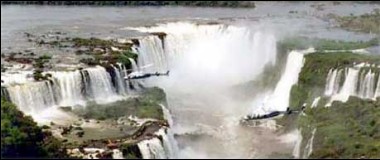
The name Iguassu simply means great waters in the local Indian language. According to legend, the great waterfall was created in an outburst of rage by the god of the Iguassu River, who lived in a particularly wild and violent area of the downpour called the Garganta do Diablo (Devils Throat). The Falls are close to the point where the Iguassu and the Parana rivers join and the boundaries of Brazil, Argentina, and Paraguay converge. The countries are linked by two bridges: the Amizade (Friendship) Bridge between Brazil and Paraguay, and the Tancredo Neves Bridge between Brazil and Argentina.
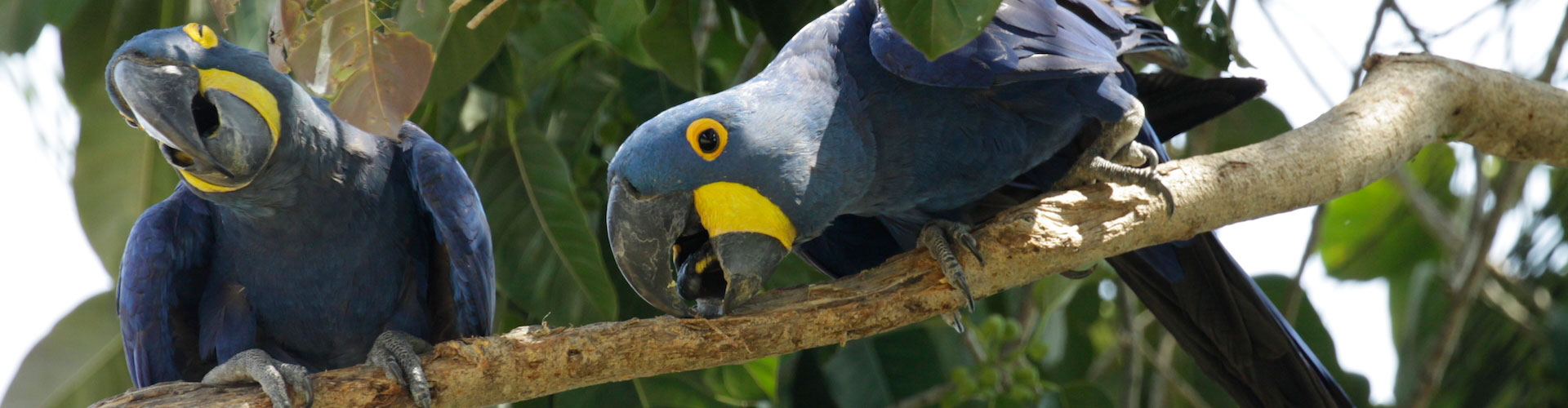
The National Park of Iguassu is really breathtaking. The Falls, which would be memorable in any setting, are made all the more beautiful by their lush surroundings. The luxuriant forests are filled with bamboos, palms, and delicate tree ferns. Brilliantly feathered parrots and macaws flit through the foliage, competing for attention with the exotic blooms of wild orchids, begonias, and bromeliads.
Infrastructure
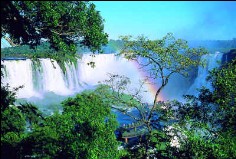
Designated officially as the Iguassu International Touristic Pole at the meeting point of three countries, the Iguassu Falls area has a population of nearly 400.000 inhabitants.
The region has three international airports: Foz do Iguaçu (Brazil), Puerto Iguazu (Argentina) and Ciudad del Este (Paraguay).
The Pole is connected to the world by more than 20 daily flights through the main gateways of South America – Buenos Aires, Rio de Janeiro, São Paulo and Asunción.
The hotel infrastructure is top level with approximated 24.000 beds, besides convention centers, bus terminals, transportation, multilingual tour guides, theme parks, shows, golf courses, banks, hospitals, casinos among other things, makes the region a versatile and well prepared support base to serve the different segments of the tourism market.
Climate
The climate is subtropical and humid, and mean temperatures range from 5o C to 25o C from May to August and from 15o C to 42o C November through March. Rainfall is rather regular year-round and humidity is stable at 80% most of the time.
Gastronomy
Typical gastronomy is varied and based on beef (barbecue), barreado (a typical meat stew from Paraná State) pork, boi no rolete (an entire ox roasted on live coal); fresh water fish, stewed surubi (cat-fish), roasted dourado fish, always accompanied by hot side dishes and a great assortment of salads and vegetables including manioc or cassava prepared in many different ways.
Foz do Iguaçu general Data:
- Geographic location: 25º32’45” latitude South/ 54º53’07”longitude West; 7,5 km from the mouth of the Iguassu River
- City Population: 280.000 inhabitants as of 2005
- Average Altitude: 192 meters above sea level
- Climate: Subtropical mesothermic humid
- Rainfall: 1.200mm/year with regular rainfall year-round
- Relative Air Humidity: 80%
- Temperature: Average in summer: 27ºC/Average Winter: 17ºC
- Hottest months: December, January, February
- Coldest months: May, June, July
- Type of soil: Clay, deep from basalt rock decomposition
- Hotel Capacity in Beds: 12.000 beds
Distance from Foz do Iguaçu to:
- Curitiba: 650 km
- Rio de Janeiro: 1.400 km
- São Paulo: 1.050 km
- Asunción: 320 km
- Posadas: 320 km
- Buenos Aires: 1.650 km
- Montevideo: 1.500 km